

Financial Education for Children: What They Learn at Each Age and How to Teach Them About Money
From the piggy bank to the 8th grade budget: what the school curricula say, the values behind money, and 12 activities for home and the classroom.
Financial education teaches children what money is, where it comes from, how to divide it up, how to save, and how to make choices. At school, money shows up in math class from the early grades, and since 2020-2021 economic and financial education has been mandatory in 8th grade, one hour per week.
Below you'll find, by age, what your child learns and what you can do at home, what the 8th grade subject covers, the values behind money, and 12 activities, with printable worksheets.
How well are you preparing your child to handle money? 5 questions
Choose the answer that seems right to you. After each question you'll see the explanation, and at the end you'll get the activity sheets for free.
This is not a psychological test. The answers come from this guide and its sources.
On Tuesday, your child spent the whole week's allowance.
What do you do on Thursday when they ask you for money for ice cream?
With no extra money, your child learns to make their allowance last. Talking it through without blame turns the mistake into a cheap lesson.
In what grade does economic and financial education become mandatory?
Choose the correct answer.
Since the 2020-2021 school year, economic and financial education has been taught in 8th grade, one hour a week, as part of Social Education.
Your child wants an expensive toy.
What helps them the most?
A savings plan shows them that big wishes are reached in small steps. Patience is learned by practicing it.
At the checkout, you get back more change than you should.
What does your child see you do?
Children learn honesty more from what they see than from what they hear. Money is a good place to show your values, not just talk about them.
Your 8th grader wants a new phone plan.
What exercise helps them?
The 8th grade curriculum requires students to compare the benefits and risks of financial products. At home, a phone plan offer is the perfect exercise.
You got 0 out of 5 right.
You're preparing your child really well.
The activity sheets give you new ideas by age, including the “My Budget” table for middle school.
You're on the right track.
The guide covers, by age, what your child learns about money and what you can do at home. The sheets are ready to print.
The guide is worth reading.
Money is best learned at home, in small steps. The guide and the activity sheets show you how, from the piggy bank to a middle school budget.
What Is Financial Education
Financial education means knowing what money is and what you can do with it: earning it through work, dividing it between needs and wants, setting some aside, comparing before you buy, and not getting fooled. For a child, it starts with a simple question: “What do I choose to do with my money?”
It's not a subject about big numbers. It's about small, repeated habits: pocket money stretched over a week, a wish put off until the money is saved up, the change handed back at the register. The child who practices these choices early becomes the teenager who reads an offer before signing.
Why It Matters in Romania
Today's adults grew up without lessons about money. The 2023 Eurobarometer shows where we stand.
Romania Compared to the European Union Average
Percentages of adults surveyed in each country, Flash Eurobarometer 525, 2023
Source: European Commission, Flash Eurobarometer 525, Romania country factsheet, and Edupedu.ro. Knowledge was measured with 5 questions about interest, inflation and risk. The bars are drawn on a scale from 0 to 62.5%.
Romanians rank first in the EU for how much they think they know about money and last for how much they actually know.
The gap between how much we think we know and how much we actually know is where costly mistakes happen: a loan taken out in a hurry, an offer left unread, savings that aren't there when you need them. That's why what children learn now, at home and at school, matters.
What Children Learn, by Age
What the school curricula say, rewritten in plain language for parents, and what you can do at home at each age. The full text of the curricula is listed in the sources.
Preparatory grade through grade 2
At school
In Mathematics and Environmental Exploration, children learn about the leu and the ban (1 leu = 100 bani), recognize coins and banknotes, and make exchanges of equal value. In grade 2, the euro and its cents are introduced as well.
At home: Let your child pay for a small purchase and collect the change. Count the coins in the piggy bank together.
Grades 3 and 4
At school
In Mathematics: the leu and the ban, the euro and the euro cent, exchanges of equal value, calculations with money, and “going shopping” role-play games, with decimals and percentages.
At home: Give your child a small, fixed amount each week and let them decide what to do with it. The small mistakes they make now are the cheap lessons.
Grades 5-7
At school
The core curriculum has no subject about money in these grades. Social Education covers other topics: children's rights (grade 5), intercultural education (grade 6), democratic citizenship (grade 7). Money is learned at home or in an optional course, such as “Financial Education (My Money)” for grade 7.
At home: Show them a bill, a receipt, an ad. Together, make a plan for something they want, with money saved up over a few months.
Grade 8
At school
Economic and financial education, mandatory since 2020-2021, one hour a week: consumer rights, needs and wants, income and expenses, the family budget, banks, interest and fees, saving for children, insurance, and entrepreneurial spirit.
At home: Put together a month of the family budget together. Let them compare two offers, two phones or two subscriptions, and explain why they would choose one over the other.
Sources: Mathematics and Environmental Exploration, grade 1 and grade 2, the Mathematics curriculum, grades 3 and 4, the Social Education curriculum, grades 5-8, the “My Money” optional course.
Grade 8: Economic and Financial Education, Explained for Parents
One hour a week, all year long, with a class project on a money-related topic. The curriculum covers three main themes.
The Citizen as an Economic Actor
The consumer and the producer. What rights a person has when buying, how to file a complaint, and what initiative and risk mean for a small entrepreneur.
Money and Budgeting
Needs, wants, income, expenses. What money looks like and what it's for, the national currency, personal and family budgets, and a plan for reaching a goal.
Banking and Insurance
Saving, credit, payments. What a bank does, what savings products are available for children, interest, fees, and how to compare offers.
The curriculum suggests hands-on activities: role-plays with consumers and producers, a written complaint to the authorities, choosing an insurance policy by comparing offers, calculating interest, and a brochure made by the students: “How do I choose a bank for my first savings account?” Two of them are explained step by step in the activities below.
At home, what helps most is doing what students do at school, but with real-life examples: a month of the family budget, a bill read together, two offers compared before a big purchase.
Money and Values
Every money decision is a choice. And good choices come from values. Here are six values that money puts to the test.
Responsibility
I own my choices. If I spent it all on Monday, I wait until next week's money.
Patience
I can wait for something I really want. I save little by little, following a plan.
Honesty
If I get the wrong change, I give it back. A debt gets paid, even a small one to a friend.
Generosity
Part of my money can do good for someone else: a gift, a donation, a good deed.
Gratitude
I know how hard my parents work for their money, and I say thank you for what I get.
Courage
I can say “no” to spending money on something just because all my classmates do.
The programs of Asociația Maxwell România aren't lessons about money. They're about character: how I choose, how I own my choices, and how I influence others. Exactly what a money decision calls for, too.
Self-awareness and values: what matters to me, before I choose. And before I spend.
Responsibility and collaboration: I own my choices, including the wrong ones, and I learn from them.
Positive influence and resilience: I can say “no” to peer pressure, and I can do good for others.
The three guides are the three years of the “Education for Life” optional course for grades 5-7, which any school in Romania can choose. They are part of our personal development program for students. For more on values: the guide on moral values.
How to Teach It at Home
Six habits that matter more than any lesson. These are our suggestions.
Pocket money: a little, and no extras
A small, fixed amount, on the same day every week. No extra money when it runs out: that's how children learn to budget their money.
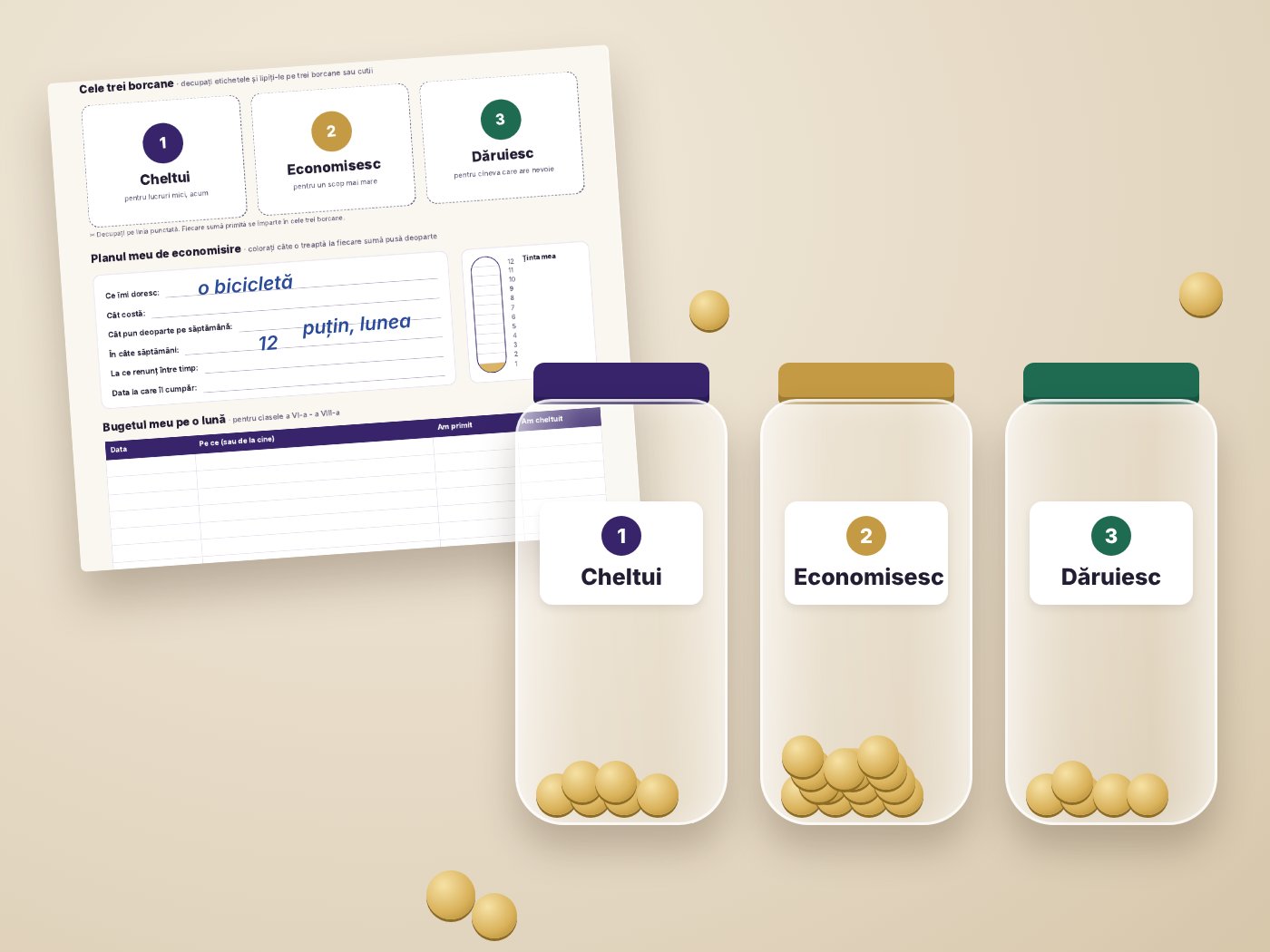
Three jars: spend, save, give
Every amount your child receives gets split three ways. Children see for themselves that money has several roles, not just shopping.
Need or want?
When you go shopping, ask: “Do we need this, or do we want it?” Both are fine, but needs come first.
Talk about money openly and without fear
Explain how you earn money and where it goes. Your child doesn't need the numbers, just to understand that money comes from work and runs out.
Let them make mistakes now, with small amounts
A toy bought in a hurry and forgotten the next day is a cheap lesson. Talk about it without blame: “What would you do differently?”
A goal, a plan, a date
For something your child wants, write down together how much it costs, how much they'll set aside each week, and when they can buy it.
Printable activity sheets
What children learn at each age, the tips, the 12 activities, labels for the three jars, the savings plan, and the “My Budget” worksheet. Free, as a PDF.
12 Activities by Age
Click an activity to see the steps, what you need, and how long it takes. “At the Store,” the bank brochure, the family plan, and the complaint letter are based on activities from the school curricula. The others are our suggestions.
1. First Steps with Money
For the preparatory grade through grade 2
The Classroom Store
Children set up a store with prices, paper money and a cashier who gives change.
40 minutesAges 6-8
How to do it
- Children bring toys or draw products and give them simple prices.
- They make coins and bills out of cardboard.
- Taking turns, some are sellers and others are shoppers with a set amount of money.
- At the end, each child says what they bought, what they have left and what they wanted but couldn't afford.
What you need
Cardboard, markers, toys or drawings of products.
The takeaway: Money runs out, so I have to choose.
The Three Jars
Three jars with labels: spend, save, give.
20 minutes, then a few minutes each weekAges 5-10
How to do it
- Decorate three jars and stick on the labels from the printable sheet.
- Every time your child gets money, they split it among the three jars.
- Decide together what each one means: a small purchase, a bigger goal, a gift for someone else.
- Once a month, open the “give” jar and decide together who you will help.
What you need
Three jars or boxes, the labels from the PDF.
The takeaway: Money has three roles, and generosity is one of them.
Need or want?
A card game: the child sorts the pictures into two piles.
15 minutesAges 6-9
How to do it
- Prepare picture cards: bread, water, a school backpack, a winter jacket, tablet games, ice cream, a new toy.
- The child places each card under “need” or “want.”
- Talk about the cards that are hard to place: a jacket is a need, but what about a third jacket?
- Wrap up: wants aren't bad, but they come after needs.
What you need
Picture cards, drawn or cut out of magazines.
The takeaway: The child starts asking the question on their own at the store.
Where Does Money Come From?
The child finds out what work the people around them do and how their work helps others.
30 minutesAges 6-9
How to do it
- Ask 3-4 adults in the family: “What do you do at work? Who does it help?”
- The child draws each job.
- Discuss: people get paid because their work helps someone.
What you need
Paper, colored pencils.
The takeaway: Money comes from work, and work is a way of helping others.
2. Choices and Saving
For grades 3-5
Shopping with a List
A role-play from the Math curriculum: children shop from a list with a set amount of money.
40 minutesAges 9-11
How to do it
- Make a shopping list for a simple meal and set a fixed amount of money.
- The children pick products from a store flyer and add up the prices.
- If they go over the amount, they give something up and explain why.
- Compare the lists: who spent less and still got everything they needed?
What you need
Store flyers, paper, pencil.
Takeaway: A budget forces you to make choices, and choices have reasons.
My Savings Plan
The child picks something they want and makes a week-by-week plan.
20 minutes, then a few minutes a weekAges 8-12
How to do it
- The child picks something they want and finds out how much it costs.
- They figure out how much they can set aside each week.
- They draw a thermometer with as many lines as the number of weeks they need.
- They color in one line each time they set money aside.
What you need
The “My Plan” worksheet from the PDF, or a sheet of paper.
Takeaway: Patience has a plan, and you can see the plan.
Ad Detective
The children analyze three ads and look for what they promise and what they leave out.
30 minutesAges 9-13
How to do it
- Choose three ads aimed at children: for toys, sweets, online games.
- For each one, the children answer: What do they want me to feel? What do they promise? What don't they say?
- Talk about in-game purchases: real money spent on things that don't exist.
What you need
Three ads, printed or on screen.
Takeaway: An ad wants something from me. I can stop and think.
The Good Deeds Box, with money raised together
As a class project, the class collects money or items for someone in need.
A few weeksAges 9-13
How to do it
- The class chooses a cause: an animal shelter, a family in the neighborhood, a library.
- The children suggest ways to raise money: a fair with things they made themselves, a bake sale.
- They keep track of how much they raised and what the money is spent on.
- At the end, they deliver the gift together and talk about how they felt.
What you need
Consent from parents and the school, a notebook for keeping records.
Note: An adult holds the money raised, and the records are shown to everyone.
Takeaway: Money can do good, and transparency is part of honesty.
3. Budgeting and Being a Smart Consumer
For grades 6-8
My Monthly Budget
For one month, the student writes down what they receive and what they spend, then draws conclusions.
One month, a few minutes a dayAges 11-14
How to do it
- The student fills in the “My Budget” table from the PDF: what they receive, what they spend, and on what.
- At the end of the month, add everything up by category: food, fun, savings, other.
- Answer: What surprised me? What would I change?
- Makes next month's budget before the month begins.
What you need
The table from the PDF, a pencil.
Takeaway: A budget isn't a ban; it's a plan I make myself.
How do I choose a bank for my first savings account?
Activity from the 8th grade curriculum: students compare offers and make a brochure.
2 hoursAges 13-14
How to do it
- Students look up what three banks offer kids on their websites: savings accounts, cards, apps.
- They make a table: interest rate, fees, what the bank requires, what the child can do on their own.
- They choose the option they would recommend to a classmate and explain why.
- They make a one-page brochure for the class.
What you need
A computer or phone with internet access, paper.
Note: This is a comparison exercise, not a recommendation: opening an account is the parents' decision.
Takeaway: Before I sign, I read and compare.
A family plan for a goal
Based on the “I Challenge You to Be Creative!” activity in the curriculum: a family plan for a shared goal.
One eveningAges 12-14
How to do it
- The family chooses a goal: a trip, something for the house.
- The student writes down the steps: how much it costs, where the money comes from, what the family gives up, and how long it will take.
- They present the plan to the family and adjust it based on what the others say.
What you need
The “My Plan” worksheet from the PDF.
Takeaway: Big goals are reached through small steps, written down on paper.
I'm a consumer: my complaint
From the 8th grade curriculum: students write a complaint about a defective product.
45 minutesAges 13-14
How to do it
- We start with a scenario: a pair of headphones broke one week after being bought.
- Students learn what rights buyers have and who to contact: first the store, then the Consumer Protection Authority.
- They write a short, polite complaint stating the facts, the date, and what they are asking for.
- They read the complaints in pairs and improve them.
What you need
Paper or a computer.
Takeaway: I have rights as a buyer, and I know how to claim them calmly, in writing.
Frequently Asked Questions

The association's programs are based on the ideas of John C. Maxwell, author of more than 100 books on leadership. The idea that ties them together: influence is built on character, and character is formed early.
The “iChoose,” “iDo,” and “iLead” guides used in schools were created by his nonprofit foundation, Maxwell Leadership Foundation, and Asociația Maxwell România translated and adapted them for schools in Romania. About John C. Maxwell and the schools program.
Sorin Popa, President of Asociația Maxwell România and of Maxwell Leadership România.
Last reviewed: November 20, 2026. Written by the Asociația Maxwell România team.
Sources
What children learn at each age comes from the school curricula. The figures about adults come from the 2023 Eurobarometer. The tips and most of the activities are our own suggestions.
- Curriculum for the Social Education subject, grades 5-8, approved by Minister's Order no. 3393/28.02.2017: the topics for each grade, the competencies, and the activities from grade 8, Economic and Financial Education, including the leaflet “How do I choose a bank for my first savings account?” and “I challenge you to be creative!”.
- Ministry of Education: the financial education course for grade 8 Social Education teachers: financial education has been a mandatory subject in grade 8 since the 2020-2021 school year, as part of the Social Education subject.
- Curriculum for the Mathematics subject, grades 3 and 4, approved by Minister's Order no. 5003/02.12.2014: the leu and the ban, the euro and the euro cent, equal-value exchanges, and “shopping” role-play games.
- Lesson plan for the Mathematics and Environmental Exploration textbook, grade 1 (Editura Litera), based on the curriculum approved by OM 3418/19.03.2013: the leu (1 leu = 100 bani), coins and banknotes, equal-value exchanges.
- Lesson plan for the Mathematics and Environmental Exploration textbook, grade 2 (Editura Litera): larger banknotes and the euro (1 euro = 100 cents), with its coins and banknotes.
- European Commission, Flash Eurobarometer 525: Monitoring the level of financial literacy in the EU (2023): the financial knowledge of adults in each country, their self-assessment, and their emergency savings. For Romania: 1,063 interviews, between March 29 and April 5, 2023.
- Edupedu.ro: Romanians rank first in the EU in how much they think they know about money and last in actual knowledge (July 22, 2023): Romania's results in the 2023 Eurobarometer, explained.
- Junior Achievement România: curriculum for the “Financial Education (My Money)” optional course, grade 7: a one-semester optional course about money that schools can choose.
See also
Civic Education for Kids
Rights, rules, community, and democracy, by age, with 12 activities.
Read the guide →The Reward Chart
Good habits, stars, and a reward that doesn't undermine motivation.
Make the chart →Moral Values
What they are, 12 examples kids can understand and how they are learned.
Read the guide →All our guides: Bullying in Schools · Moral Values · Emotional Intelligence and Self-Esteem · Conflicts Between Children and Nonviolent Communication · Școala Altfel: Activity Ideas · Green Week: Activities and Rules · The Emotion Wheel · Volunteering in Education · Assertive Communication · Personal Development, Grades K-2 · Classroom Rules · Empathy in Children · Emotion Coloring Pages · Christmas in the Classroom · Form 230, Step by Step · The Good Deeds Advent Calendar · Reward Chart for Kids · The Letter to Santa Claus · Civic Education for Kids
Want lessons about choices and values at your school?
The “Education for Life” optional course and the MaxLeaders program bring lessons on character, responsibility, and choices to the classroom. Write to us and we'll tell you how your school can join the program.