

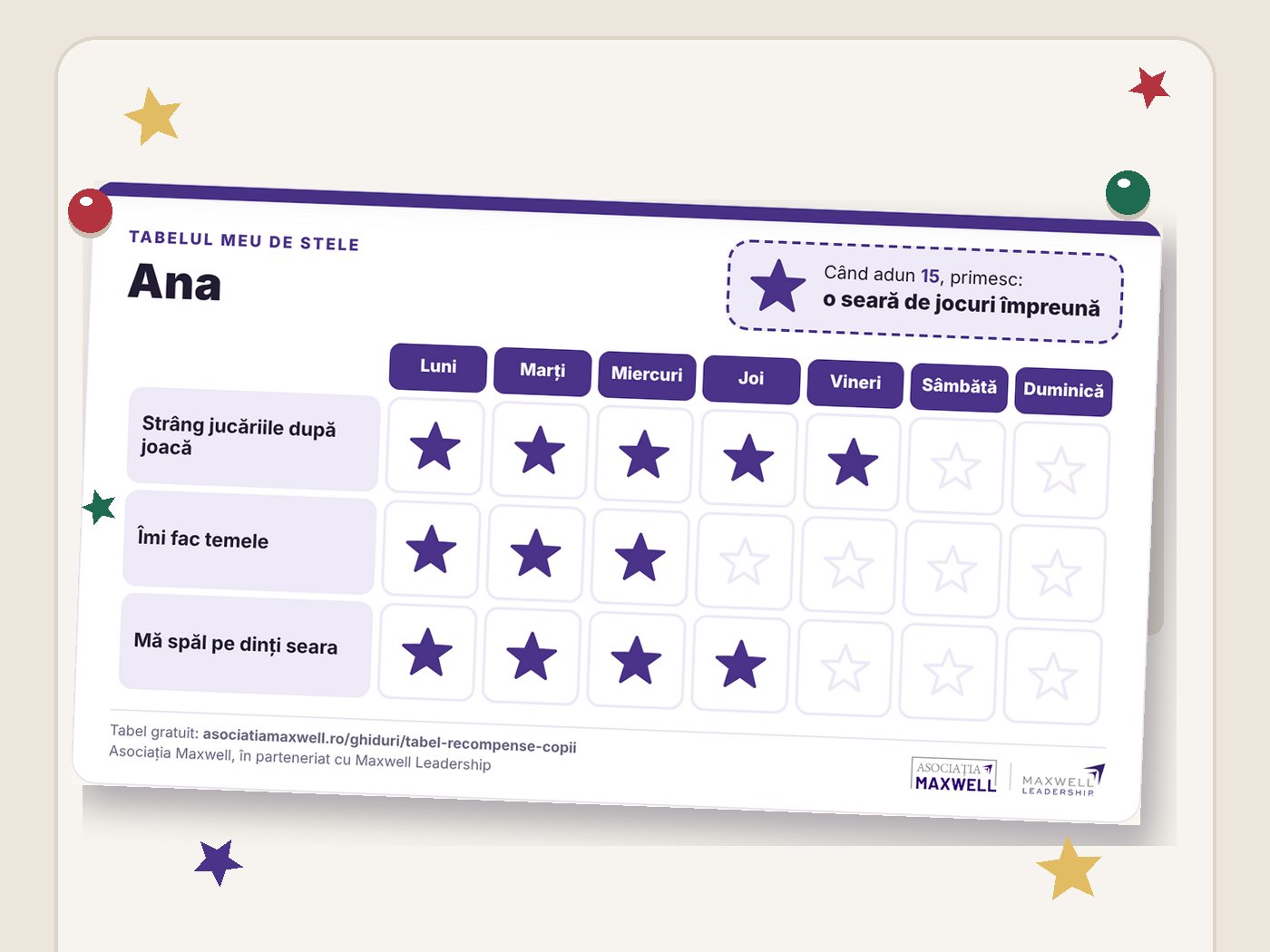
Reward Chart for Kids
Make it in 2 minutes: your child's name, 1-3 habits, stars and a reward you choose together. Print it or add the stars right on the screen.
A reward chart is a sheet on which a child gets a star every time they practice a habit they're learning, for example picking up their toys. When they collect the agreed number of stars, they get a small reward you've chosen together.
It works best for children ages 3-8, with 1-3 habits phrased positively, with the star given right away, and with stars that are never taken back. You can make the chart below in 2 minutes, for free.
Are You Using Rewards Well? 5 Scenarios
Choose the answer that seems right to you. After each scenario you'll see an explanation, and at the end you'll make your child's chart, for free.
This is not a psychological test. The answers come from this guide and its sources.
Your child has earned 4 stars, then hits his brother.
What do you do with the stars?
What's been earned isn't taken back. If stars can be lost, the chart becomes a punishment and the child gives up trying.
You want your daughter to stop yelling when she's upset.
How do you write the habit on the chart?
Children need to know what to do, not just what not to do. A habit written clearly and positively can also be observed: either they did it or they didn't.
Your child already loves to draw, on their own, for hours.
Do you put it on the chart, with a toy at the end?
In an analysis of 128 experiments, material rewards promised in advance reduced enjoyment of activities people already liked, especially in children.
Your child has reached 10 stars.
Which reward do you choose?
Small rewards, especially time spent together, often work better than expensive things. And you can give them often.
After three weeks, your child makes their bed without being reminded.
What do you do with the chart?
When the chart stops abruptly, the old habit easily comes back. Phasing it out gradually helps the child keep what they've gained.
You got 0 out of 5 right.
You know how to make rewards a help, not a bribe.
Now all you need is the chart. You can make it in 2 minutes, below.
You're on the right track.
What matters most: a few habits, written positively, and stars that can't be lost. The chart below has all of these.
It's worth reading this page all the way through.
A well-made reward chart is a simple, gentle tool. You can make one below in 2 minutes.
Make Your Child's Chart
Choose together with your child. The chart updates instantly, and you can also add stars right on the screen: just tap the box for the day.
No more than 3 habits at a time. Remove one to choose another.
The chart is wide: swipe it to the left to see the whole week.
| Monday | Tuesday | Wednesday | Thursday | Friday | Saturday | Sunday |
|---|
Choose at least one habit.
Asociația Maxwell, in partnership with Maxwell Leadership


Great job! You've reached the goal. It's time for the reward and for specific praise: what did your child do well?
How to Use It, in 5 Steps
Choose together
One or two habits, written clearly, and the reward your child wants. When your child helps choose, the chart becomes theirs.
Put it where it can be seen
On the fridge or on the bedroom door, at your child's eye level. Briefly explain what they need to do to earn the star.
The star, right away
Give the star right after the habit is done, with specific praise: “You put all the blocks back in the box. Great job!”
Stars are never lost
What has been earned stays earned. If today didn't go well, tomorrow is a new chance, with no reproaches.
The reward, on time
Once your child has collected the stars, they get the promised reward, without delay. Then set the next goal together.
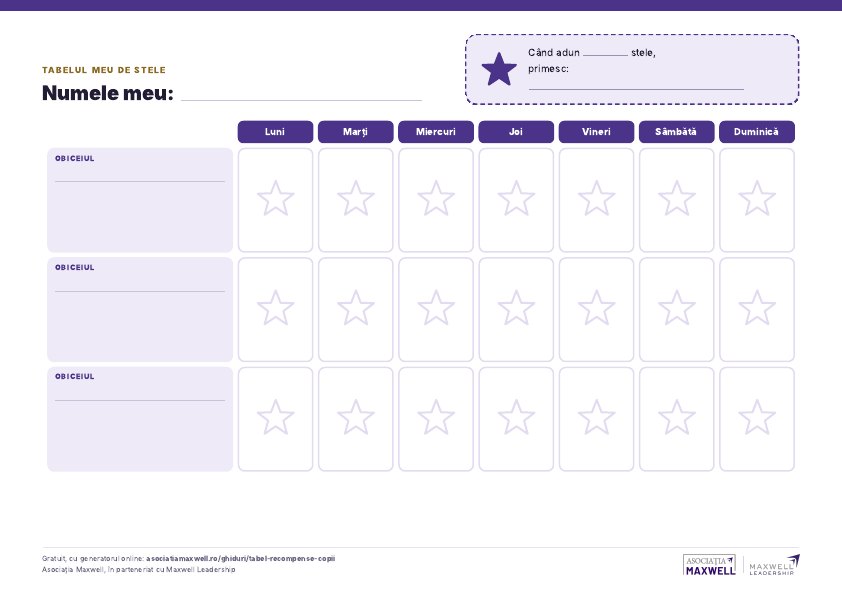
The blank chart, to fill in by hand
3 A4 pages: steps for the adult and reward ideas, a one-week chart and a 4-week chart, with space for the child's name, habits, and reward. Free, as a PDF.
Which habits to choose
Things your child can already do but still finds hard. A good habit for the chart is easy to see: they either did it or they didn't.
Ages 3-5
- I put away my toys after playing
- I brush my teeth
- I sleep in my own bed
- I say “please” and “thank you”
Ages 6-8
- I get dressed by myself, on time
- I do my homework
- I read for 15 minutes
- I pack my school bag the night before
Ages 9 and up
- Points instead of stars
- A goal the child chooses
- An agreement written together
- Activity rewards
Write the habit as something the child does, not something they shouldn't do. “I speak in a calm voice” can be learned, but “I don't yell anymore” doesn't say what to do instead. And keep the list short: one or two to start, three at most (CDC; Raising Children Network).
Rewards That Don't Undermine Motivation
The best rewards are often free: attention, specific praise, time spent together. A board game, an extra story, a walk, or getting to choose what you cook on Sunday often works better than an object (CDC).
Watch out for one thing. In an analysis of 128 experiments, material rewards promised in advance reduced enjoyment of activities people already liked, and the effect was stronger in children. Positive feedback did not have this effect (Deci, Koestner, and Ryan, 1999). In short: only put on the chart what is still hard, not what your child already enjoys doing, and praise the effort, not just the result.
Common Mistakes
When to Stop Using the Chart
The chart is scaffolding, not a house. When the habit starts coming naturally, give stars less and less often: first daily, then every other day, then once a week, with more and more praise. Once the habit is formed, choose another one together or set the chart aside (Raising Children Network).
If the chart isn't working after a week or two, make the habit easier or clearer, swap the reward for one your child really wants, and be patient: change takes time (CDC). You can find more about praising effort in the guide on emotional intelligence and self-esteem.
Frequently Asked Questions

The association's programs are based on the ideas of John C. Maxwell, author of more than 100 books on leadership. The idea that ties them together: influence is built on character, and character is formed early.
The “iChoose,” “iDo,” and “iLead” guides used in schools were created by his nonprofit foundation, Maxwell Leadership Foundation, and Asociația Maxwell România translated and adapted them for schools in Romania. About John C. Maxwell and the schools program.
Sorin Popa, President of Asociația Maxwell România and of Maxwell Leadership România.
Last reviewed: November 19, 2026. Written by the Asociația Maxwell România team.
Sources
The tips on this page come from the sources below. The generator, the suggested habits, and the blank chart are our own.
- Centers for Disease Control and Prevention (CDC), “Tips for Using Rewards”: a few clear behaviors, described in terms of what the child does; give the reward right afterward; social rewards (attention, praise, time together) are often more powerful; what has been earned is not taken back; reward less often as the behavior becomes a habit.
- Raising Children Network (Australia), “Reward charts”: charts work best for children around 3-8 years old, with one behavior at a time; stars are not taken back; phase the chart out gradually, with rewards becoming less and less frequent.
- Edward L. Deci, Richard Koestner, and Richard M. Ryan, “A Meta-Analytic Review of Experiments Examining the Effects of Extrinsic Rewards on Intrinsic Motivation,” Psychological Bulletin, vol. 125, no. 6, 1999, pp. 627-668: 128 experiments: tangible rewards promised in advance reduced interest in activities that were already enjoyable, especially in children; positive feedback did not have this effect.
- Asociația Maxwell România's guide “Emotional Intelligence and Self-Esteem”: how to praise effort and how to talk with your child about emotions.
See also
Emotional Intelligence and Self-Esteem
How to help your child understand their emotions and believe in themselves.
Read the guide →Classroom Rules
Positively worded rules, set together with the students, and a poster to display.
Read the guide →Moral Values
What values are and how to nurture them in children, at home and at school.
Read the guide →All our guides: Bullying in Schools · Moral Values · Emotional Intelligence and Self-Esteem · Conflicts Between Children and Nonviolent Communication · Școala Altfel: Activity Ideas · Green Week: Activities and Rules · The Emotion Wheel · Volunteering in Education · Assertive Communication · Personal Development, Grades K-2 · Classroom Rules · Empathy in Children · Emotions Coloring Pages · Christmas in the Classroom · Form 230, Step by Step · The Advent Calendar of Good Deeds · The Letter to Santa Claus
Good habits grow with patience, not pressure.
Teachers in the MaxLeaders program teach classroom lessons about values, relationships and choices. Write to us and we'll tell you how your school can join the program.