

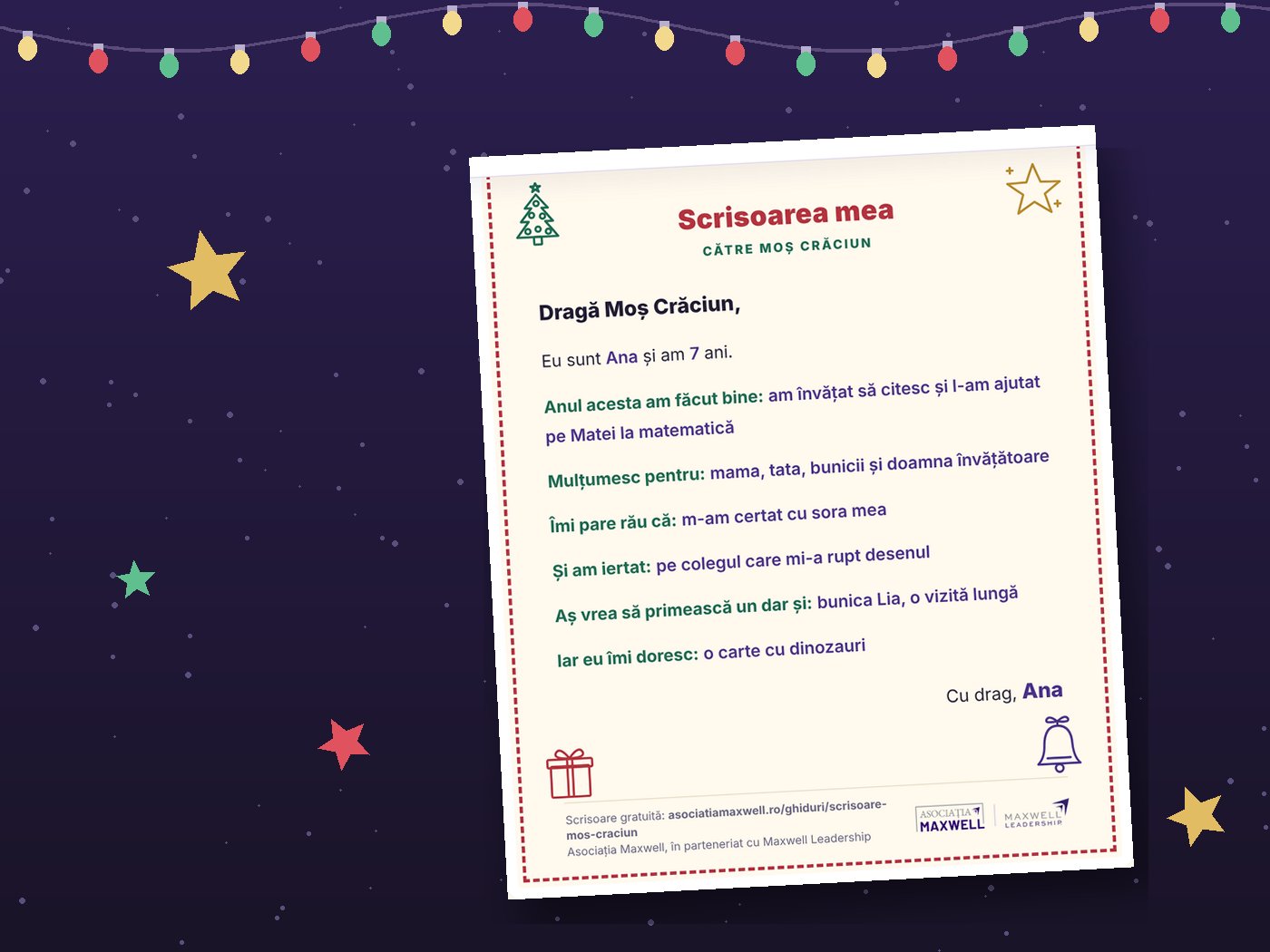
Letter to Santa Claus
Your child fills it out on the page and you print it right away: what they did well, what they're thankful for, forgiveness, a gift for someone else, and only then their own wish.
Our letter to Santa has 6 parts: who the child is, what they did well this year, what they're thankful for, what they're sorry for and whom they've forgiven, a gift for someone else, and only at the very end what they wish for.
Your child fills it out below, with your help, and you print it right away. For little ones and for the classroom, the PDF includes the blank letter and a version with drawings. Nothing you write ever leaves the page.
Letter to Santa: 5 Situations
Choose the answer that seems right to you. After each situation you'll see the explanation, and at the end you write the letter together, for free.
This is not a psychological test. The answers come from this guide and its sources.
Your child wrote a list of 15 presents.
What do you do?
Order matters. When they write about their year and about others first, their wishes naturally become fewer and more thoughtful.
Your child only writes “Thank you for everything.”
How do you help them?
Gratitude grows when children name specific things. Students who regularly wrote about the good things in their lives became more grateful and more satisfied with school.
Your child doesn't want to forgive the classmate who hit them.
What do you do?
Forgiveness can't be rushed, and it doesn't mean that what happened is okay. A hurt child first needs to be listened to and protected.
The 5-year-old little brother wants a letter too.
What do you do?
Young children say a lot through drawing. The letter for little ones in the PDF has drawing boxes for each part.
Christmas is over.
What do you do with the letter?
Reread a year later, the letter shows your child how much they've grown. And it stays yours, not the internet's.
You got 0 out of 5 right.
You know how to turn the letter into a lesson about gratitude and forgiveness.
Now write it together. Fill it in below and print it right away.
You're on the right track.
What matters most is the order: first the year and other people, then the wish. The letter below already follows it.
It's worth reading this page all the way through.
A letter to Santa Claus can be more than a gift list. Below, you can write one together in just a few minutes.
Write the Letter
Write in your child's own words, or tap an idea to add it. The letter on the right fills in as you go.
My Letter
to Santa Claus
Dear Santa,
My name is and I am years old.
This year I did these good things:
Thank you for:
I'm sorry that:
And I forgave:
I'd like a gift for someone else too:
And as for me, I wish for:
Love,
Asociația Maxwell, in partnership with Maxwell Leadership


What you write stays only in this browser. Nothing reaches us, and the letter isn't sent anywhere: you print it out and put it wherever your family tradition says.
How to Write It Together
Talk First
In the evening, without rushing: What was good this year? What was hard? Who would you like to make happy at Christmas? The letter grows out of the conversation.
In Their Own Words
The ideas on the page are only there to help. What your child says, in their own words, is worth more than a beautiful sentence.
Print and Keep
Put the letter in the window, under the tree, or in a boot. After the holidays, keep it in an envelope and read it again next year.
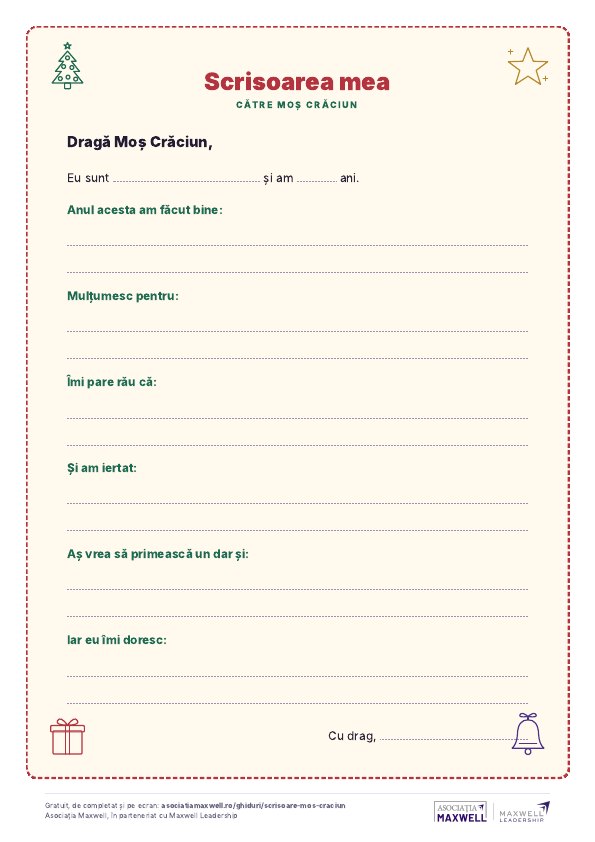
The blank letter, to fill in by hand
3 A4 pages: tips for the adult, the letter to write, and the letter for little ones, with drawing boxes for each part. Great for home and the classroom. Free, in PDF.
Why It Has 6 Parts
The order is intentional: first the year and other people, and only at the end the wish. That way the letter teaches something instead of just asking.
- Who I amName and age. Read again years later, the letter shows how much the child has grown.
- What I did wellThe child looks back and sees what they accomplished. It's the first step toward self-confidence.
- Thank you forSpecific people and things. Gratitude grows when it's expressed concretely (Froh et al., 2008).
- I'm sorry and I've forgivenA year that ends in peace. Lessons about forgiveness reduce children's anger (Rapp et al., 2022).
- A gift for someone elseThe joy of giving shows up early, even before age 2 (Aknin et al., 2012).
- What I wish forOne or two wishes, chosen after the child has thought about the year and about others.
How to Talk About Forgiveness
Forgiveness is one of the hardest and most beautiful lessons. For a child, it can start simply: an “I'm sorry” said to someone they love and an “I forgive you” said to someone who upset them. In an analysis of 20 studies with 1,472 children and adolescents from 10 countries, lessons about forgiveness reduced anger and helped children forgive more easily (Rapp, Wang Xu, and Enright, 2022).
Tell your child three things. Forgiveness doesn't mean that what happened was okay. It doesn't mean they have to forget or let themselves be hurt again. And it can't happen on command: it comes when they're ready.
In the Classroom
One Hour Before Vacation
Print the blank letter from the PDF. Each child fills it in, and the little ones draw in the version made for them.
The Thank-You Circle
Anyone who wants to can read just the “Thank you for” part. The part about forgiveness stays private to each child.
The Class Gift
The “A gift for someone else” part can turn into a good deed for the whole class, like in the Advent calendar of good deeds.
Frequently Asked Questions
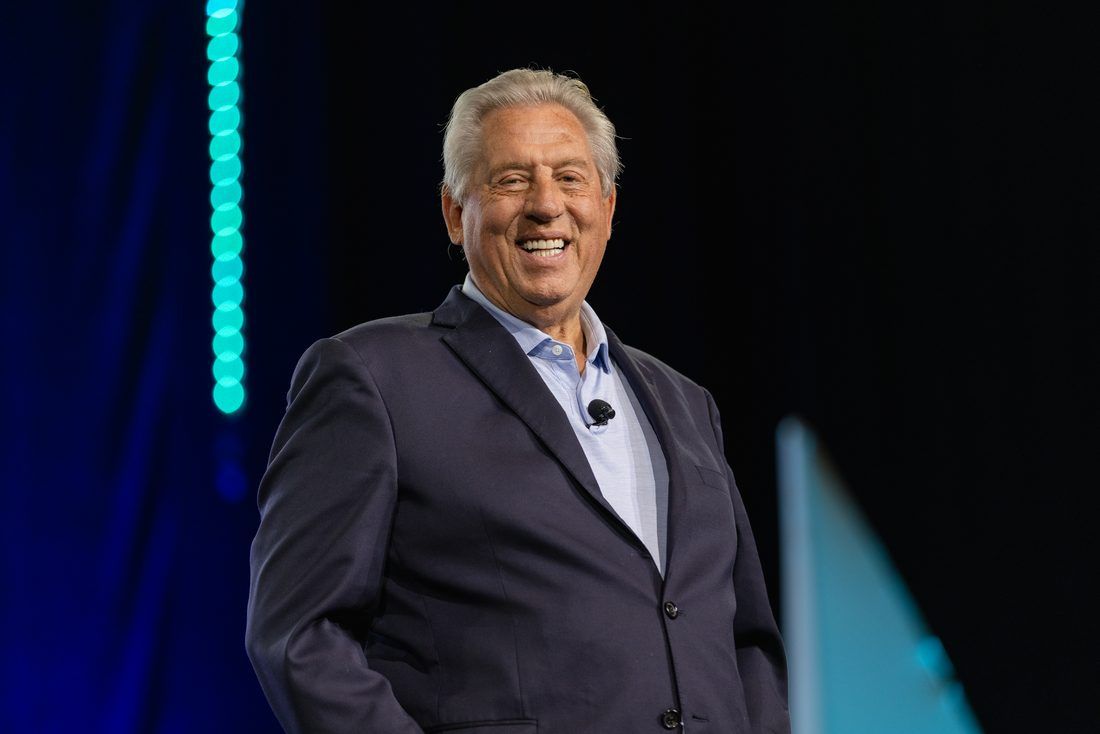
The association's programs are based on the ideas of John C. Maxwell, author of more than 100 books on leadership. The idea that ties them together: influence is built on character, and character is formed early.
The “iChoose,” “iDo,” and “iLead” guides used in schools were created by his nonprofit foundation, Maxwell Leadership Foundation, and Asociația Maxwell România translated and adapted them for schools in Romania. About John C. Maxwell and the schools program.
Sorin Popa, President of Asociația Maxwell România and of Maxwell Leadership România.
Last reviewed: November 19, 2026. Written by the Asociația Maxwell România team.
Sources
The facts on this page come from the works below. The letter, the ideas and the PDF are our own.
- Jeffrey J. Froh, William J. Sefick and Robert A. Emmons, “Counting blessings in early adolescents: An experimental study of gratitude and subjective well-being,” Journal of School Psychology, vol. 46, no. 2, 2008, pp. 213-233: 221 sixth and seventh graders from 11 classes: those who wrote down the good things in their lives became more grateful, more optimistic and more satisfied with life and with school.
- Hannah Rapp, Jiahe Wang Xu and Robert D. Enright, “A meta-analysis of forgiveness education interventions’ effects on forgiveness and anger in children and adolescents,” Child Development, vol. 93, no. 5, 2022, pp. 1249-1269: 20 studies with 1,472 children and adolescents from 10 countries: lessons about forgiveness reduced anger and increased forgiveness.
- Lara B. Aknin, J. Kiley Hamlin and Elizabeth W. Dunn, “Giving Leads to Happiness in Young Children,” PLoS ONE, vol. 7, no. 6, 2012, e39211: children under two were happier when giving than when receiving.
- Asociația Maxwell România's “Advent Calendar of Good Deeds” guide: 24 good deeds for kids, one a day in December.
- Asociația Maxwell România's “Bullying in Schools” guide: what to do when a child is repeatedly hurt, plus Telefonul Copilului, 116 111.
See also
Advent Calendar of Good Deeds
24 good deeds for kids, one a day, from December 1 to December 24.
Open the calendar →Christmas in the Classroom
Christmas coloring pages, 8 games and the skit “The Most Beautiful Gift.”
See the materials →Moral Values
What values are and how to nurture them in children, at home and at school.
Read the guide →All our guides: Bullying in Schools · Moral Values · Emotional Intelligence and Self-Esteem · Conflicts Between Children and Nonviolent Communication · Școala Altfel: Activity Ideas · Green Week: Activities and Rules · The Emotion Wheel · Volunteering in Education · Assertive Communication · Personal Development, Grades K-2 · Classroom Rules · Empathy in Children · Emotions Coloring Pages · Christmas in the Classroom · Form 230, Step by Step · Advent Calendar of Good Deeds · Reward Chart for Kids
The most beautiful gift is a child who knows how to say thank you and how to forgive.
Teachers in the MaxLeaders program teach classroom lessons about values, relationships and choices. Write to us and we'll tell you how your school can join the program.