

Școala Altfel: Activity Ideas and a Five-Day Plan
Five days without regular classes can be the best of the year or the most wasted. Here you'll find the rules in brief, 20 ideas that don't require collecting money, and a ready-made plan, Monday through Friday.
Școala Altfel is a national program of five consecutive school days in which regular classes are replaced with activities chosen based on students' needs and interests. In the 2026-2027 school year, each school chooses its own week, between September 7, 2026 and April 23, 2027.
The best weeks have a common thread: one theme per day and one thing the class carries forward. Below are 20 ideas across five themes, most of which can be done right at school at no cost to parents, plus a Monday-through-Friday plan.
What Școala Altfel Is
Școala Altfel is a national program of the Ministry of Education. It lasts five consecutive school days and is held in every primary, middle, and high school (the 2023 Methodology, Article 2). During these days, the class doesn't follow its regular timetable but a special schedule of activities.
The idea behind the program is for students to learn in ways other than sitting at their desks: through projects, debates, theater, and meetings with people from the community. The Methodology itself recommends several methods: project-based learning, the living library, forum theater, debates, and films with an educational purpose.
It is not a vacation, and it is not “the week when nothing gets done.” It is part of the 36 weeks of classes in the school year.
When It Takes Place in 2026-2027
There is no single week for the whole country. Order No. 3.194/2026 states that the “Școala Altfel” and “Săptămâna verde” programs take place between September 7, 2026 and April 23, 2027, each in a block of five consecutive school days, and each school decides its own schedule.
Two things to know:
as Săptămâna verde
The two programs are scheduled in different teaching periods. If Săptămâna verde was in the fall, Școala Altfel will be in a different period.
the chosen week
Schools had to share the structure of the school year, including these weeks, with students and parents by April 1, 2026. If you don't know it, ask your homeroom teacher.
The Rules in Brief
Six points from the Methodology approved by Order No. 6.479/2023, in plain language. The full text is listed under sources.
It is mandatory
Primary, middle, and high schools hold the program every year, and students and teachers take part.
It has a special schedule
No regular classes are held during the five days. A student's activities add up to at least as many hours as a regular school week.
Start with the students
Activities are chosen based on students' needs and interests. Students, parents, and the school's partners can all make suggestions.
It can be done with partners
Local institutions, businesses, and nongovernmental organizations can design and lead activities alongside teachers.
It can also take place outside the school
As long as safety rules are followed. Any trip must be educational and cannot last all five days.
Money does not go through students or teachers
Parents can support the activities through the parents' association. Students and school staff are not allowed to collect money from parents.
Source: Methodology for Organizing the “Școala altfel” Program, Monitorul Oficial no. 916 of October 11, 2023. This is a summary: before making decisions, read the full text.
20 Activity Ideas
Across five themes, for middle school and high school. Most can be done at school, and none of them require money from parents. These are our suggestions, not an official list.
1. About Me
Self-awareness and confidence
My Map
Each student draws on a sheet of paper what they like, what they're good at, and what they want to learn. The maps go up on the wall without names, and the class guesses whose is whose.
A Letter to Myself, One Year from Now
Students write themselves a letter, which the homeroom teacher keeps and hands back at the next Școala Altfel.
The No-Grades Day
A day of workshops where no one is evaluated. At the end, everyone shares one thing they learned about themselves.
The Living Library
People from the community come in as “books”: students “borrow” them for 15 minutes at a time and ask them about their lives and their work.
2. About Us
Relationships, conflict, bullying
Forum Theater
Students act out a conflict scene from their own lives. The audience stops the scene and suggests a different ending. Then it's played again.
The Four Steps
A nonviolent communication workshop: what I see, what I feel, what I need, what I'm asking for. Students practice with situations from recess.
Class Rules, Written by the Class
Students propose, debate, and vote on five rules. Everyone signs them, including the homeroom teacher.
Secret Friend
Everyone draws a name and, for five days, does one kind thing each day for that classmate without being found out.
3. What I Choose
Decisions, values, habits
The Debate
Two teams, a topic chosen by the students, clear rules. A third team judges and says who was more convincing and why.
My Values in Three Words
Each student picks three values from a list and describes a time when they stood by one of them.
Movie and Discussion
An age-appropriate movie, followed by three questions: what did the character choose, what did they lose, what would you have done?
A Day Without Phones
The class decides on the rules together, and at the end they talk about what was hard and what went well.
4. For Others
Community and Volunteering
One Thing Fixed
The class picks one thing in the school or the neighborhood that can be made better in a single day, and does it.
A Lesson Taught by Students
Older students prepare and teach a class for younger ones, on a topic they know well.
Thank-You Letters
Everyone writes to someone at school or in their family whom they have never thanked. The letters actually get delivered.
A Visit with a Purpose
A visit to a senior center, a shelter, or a library, prepared in advance, bringing something the students made.
5. Where I Want to Go
The Future and Careers
Parents' Jobs
Parents come in and talk briefly about what they do at work and what they wish they had known at the students' age.
A Day at the Workplace
A visit to a company, a workshop, or an institution in the community, with questions prepared ahead of time.
Me, Ten Years from Now
Everyone describes a day in their life ten years from now and the first step they can take this month.
The Project Fair
Working in teams, students spend four days preparing a project and present it on Friday, in front of parents and other classes.
For the day about relationships, you'll find more in our guides on conflicts between children and nonviolent communication and on bullying in schools. For the day about values, see our guide to moral values, with 12 examples kids can easily understand.
A Five-Day Plan
One theme per day, from “who I am” to “where I want to go.” You can use it as a whole or in parts.
| Day | Theme of the day | What you do | Matching MaxLeaders lesson |
|---|---|---|---|
| Monday | Who I am | “My map” and a letter to myself, one year from now. | Self-Esteem in Students |
| Tuesday | How I treat others | Forum theater based on a conflict in the class, and the four-step workshop. | Bullying Prevention or Nonviolent Communication |
| Wednesday | What I choose | A debate on a topic chosen by the students, then “my values, in three words.” | Healthy choices |
| Thursday | What I can do for others | “One thing fixed” at school or in the neighborhood, and thank-you letters. | A good life is built on good relationships |
| Friday | Where I want to go | “Me, ten years from now” and project presentations for parents. | Imagine your future! |
Take the plan with you to class
The five-day plan and all 20 ideas on two A4 pages, ready to print.
A good Școala Altfel week isn't measured by how many activities you managed to fit in, but by the one thing the class does differently from Monday on.
What You Can Do
Choose who you are.
If you're a teacher
Ask students ahead of time
A short survey or a homeroom period: what they'd like to do, what they've never done before, what would help them.
Choose one theme per day
Five unconnected days are quickly forgotten. A common thread running from Monday to Friday sticks.
Look for local partners
Parents with interesting jobs, a library, a company, an association. The methodology explicitly recognizes them as partners.
Check costs and travel
For any activity that costs money, the school must make sure that all the students who chose it can take part.
Leave room for a lesson about them
A class period on self-esteem, conflict or choices does more than yet another movie screening with no discussion.
Wrap up with “what we keep”
On Friday, the class chooses one thing from the week to carry forward for the rest of the year.
If you're a parent
Find out the dates early
The school chooses the week. Ask the homeroom teacher or check the school year schedule shared by the school.
Suggest an activity
Parents can come with suggestions. A class period about your job is one of the simplest and most appreciated.
Ask about costs beforehand
Financial support from parents goes through the parents' association. Teachers and students don't collect money.
Send your child to school
Școala Altfel is part of the 36 weeks of classes. It's not a vacation.
Ask in the evening what they learned
Not “what did you do?” but “what did you learn about yourself today?” The answer is longer.
Keep it going at home
If they wrote class rules at school, write three house rules together at home, too.
If you're a student
Say what you'd like to do
The schedule is built around students' interests. If you don't say anything, someone else chooses for you.
Suggest, don't just ask
“Let's have a debate about...” stands a better chance than “let's not do anything hard.”
Try something new
The workshop you're not good at is the one you have the most to gain from.
Work with someone you don't usually work with
A week without assigned seats is the best chance to get to know a classmate.
Remember one thing
At the end of each day, write a single sentence: what I learned today.
Carry something forward
Pick one thing from this week that you'll keep doing next week.
Our lessons, ready to use
Teachers in the MaxLeaders program teach lessons on character and relationships in their classrooms. They are a good fit for the Școala Altfel week and for homeroom classes.
Figures counted by Asociația Maxwell România from the reports that teachers in the MaxLeaders program submit after each lesson. They update automatically.
If you want more than one week
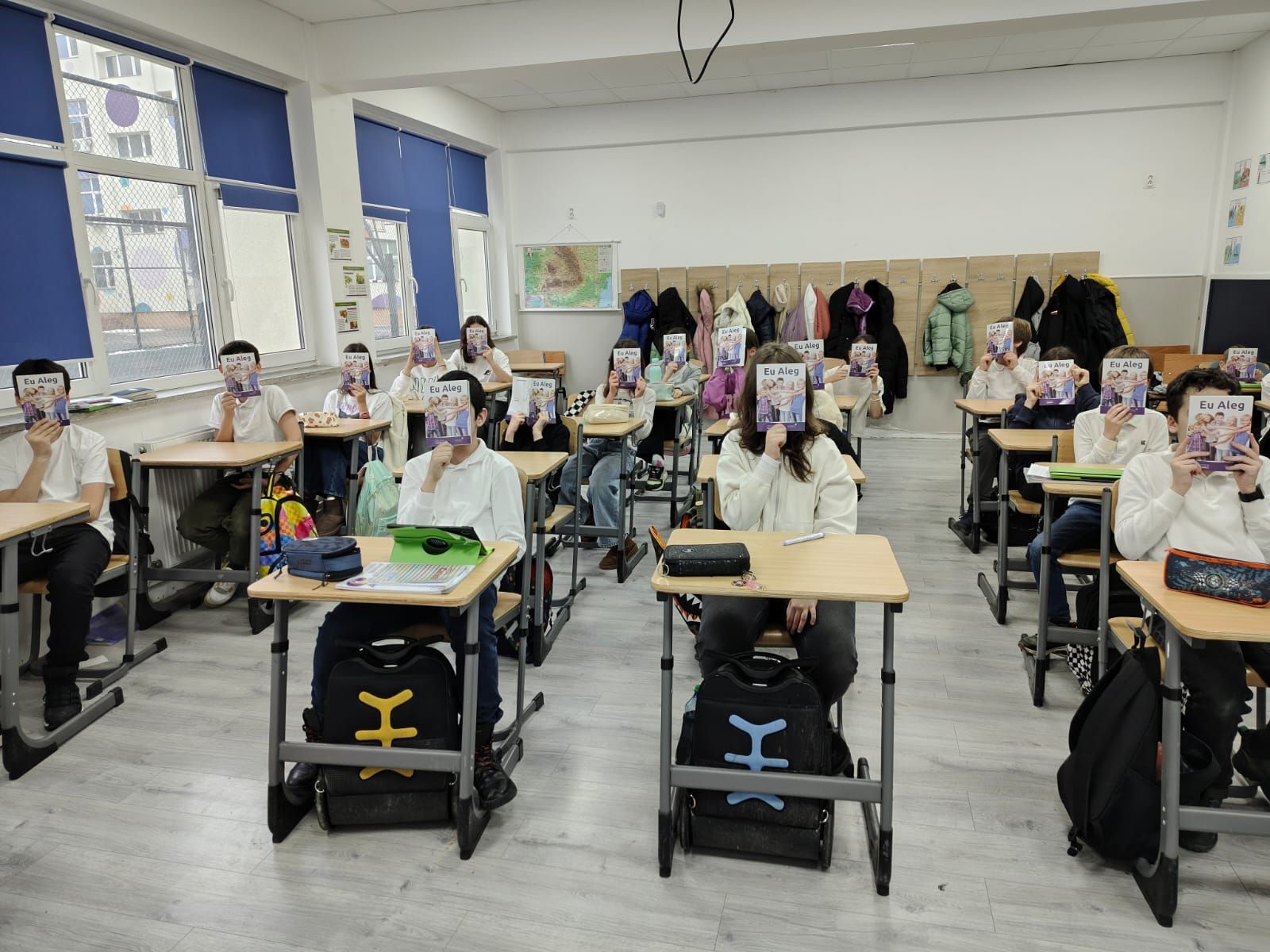
The “Education for Life” optional course, for grades 5-7, carries the same themes through the whole year: “iChoose,” “iDo,” and “iLead.” It is approved by the Ministry of Education and Research, and any school in Romania can choose it.
The lessons teachers choose most often
Lessons reported by teachers in the MaxLeaders program, by topic (top six)
Source: reports from teachers in the MaxLeaders program, counted by Asociația Maxwell România.
Frequently Asked Questions

The association's programs are based on the ideas of John C. Maxwell, author of more than 100 books on leadership. The idea that ties them together: influence is built on character, and character is formed early.
The “iChoose,” “iDo,” and “iLead” guides used in schools were created by his nonprofit foundation, Maxwell Leadership Foundation, and Asociația Maxwell România translated and adapted them for schools in Romania. About John C. Maxwell and the schools program.
Sorin Popa, President of Asociația Maxwell România and of Maxwell Leadership România.
Last reviewed: November 13, 2026. Written by the Asociația Maxwell România team.
Sources
The rules on this page come from the documents below. The activity ideas and the five-day plan are our own suggestions. The figures on the association's lessons are our own counts and are marked as such.
- Order of the Minister of Education and Research No. 3.194/2026 on the structure of the 2026-2027 school year: published in Monitorul Oficial No. 126 of February 16, 2026. Article 4 sets the period and duration of the “Școala altfel” and “Săptămâna verde” programs.
- Ministry of Education and Research: ministerial orders: the official list of orders, which includes Order No. 3.194/2026.
- Methodology for organizing the “Școala altfel” Program, approved by Order of the Minister of Education No. 6.479/2023: published in Monitorul Oficial No. 916 of October 11, 2023. It contains the rules on duration, partners, money, and trips.
- Ministry of Education: 2023 ministerial orders: the official list that includes Order No. 6.479/05.10.2023.
- Methodology for organizing the “Săptămâna verde” Program: the rules for the environment-focused program, which is not held at the same time as “Școala altfel.”
- Ministry of Education and Research: “The final version of the structure of the 2026-2027 school year has been approved”: press release of February 12, 2026.
See also
Conflicts between children and nonviolent communication
The four steps, in kids' language, and a simple five-step mediation.
Read the guide →Moral Values
What they are, 12 kid-friendly examples, and how children learn them at home and in the classroom.
Read the guide →Emotional Intelligence and Self-Esteem
What they are, what they look like in children, and how to build them, at home and in the classroom.
Read the guide →All our guides: Bullying in schools · Moral values · Emotional intelligence and self-esteem · Conflicts between children and nonviolent communication
Would you like one of our lessons during your Școala Altfel week?
The lessons are taught in class by teachers in the MaxLeaders program. Write to us and we'll tell you how your school can join the program.