

Wheel of Emotions: the basic emotions and how to use it with kids
A child who says “I feel bad” may be sad, scared, or angry. The wheel of emotions helps them find the right word. Here you'll find the wheel explained in plain language, 12 activities by age, and a printable wheel.
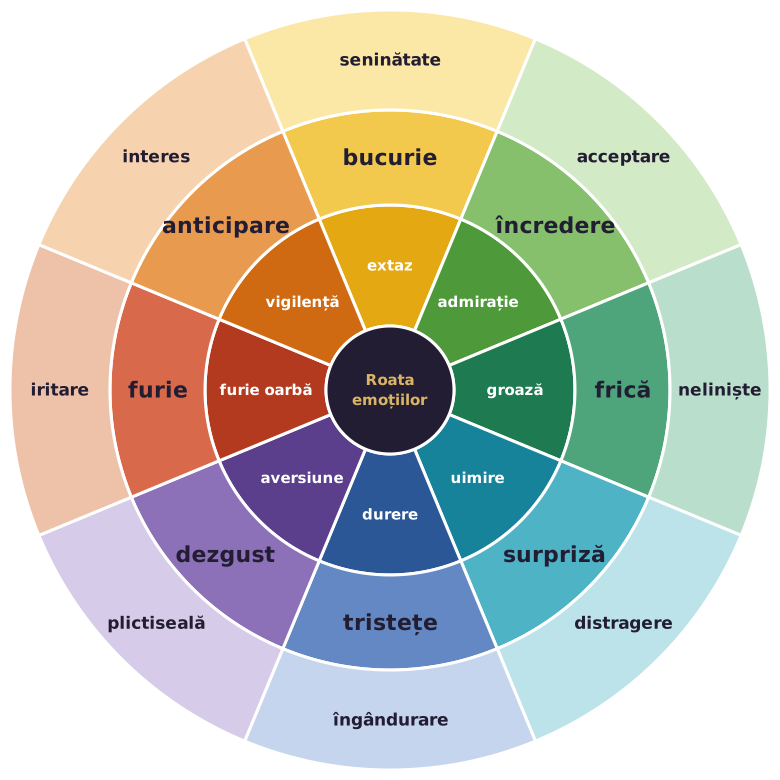
The wheel of emotions arranges emotions in a circle so you can see how they relate to each other. The best known one, created by psychologist Robert Plutchik, has eight basic emotions: joy, trust, fear, surprise, sadness, disgust, anger, and anticipation. Each one comes in three intensities, and opposite emotions sit across from each other.
Young children learn four basic emotions at school: joy, sadness, fear, and anger. The Personal Development curriculum even suggests the “Wheel of Emotions” game. Below you'll find the wheel with all the words, 12 activities by age, and a printable PDF.
How well do you know the wheel of emotions? 5 questions
Choose the answer that seems right to you. After each question you'll see the explanation, and at the end you'll get the printable wheel for free.
This is not a psychological test. The answers come from this guide and its sources.
Your child comes home from school and just says: “I feel bad.”
Which question helps them the most?
When a child finds the word, the emotion calms down. In a 2007 study, naming the emotion reduced the response of the amygdala, the part of the brain that reacts to danger. The wheel gives them the words.
You're looking at Plutchik's wheel.
How many basic emotions does it have?
Eight: joy, trust, fear, surprise, sadness, disgust, anger, and anticipation. Each one has three intensities.
On the wheel, opposite emotions sit across from each other.
What is the opposite of fear?
On Plutchik's wheel, fear and anger are opposites: fear makes us pull back, anger makes us confront.
You're preparing a Personal Development lesson for the preparatory grade.
Which basic emotions does the curriculum name?
The Personal Development curriculum for the preparatory grade through 2nd grade names four basic emotions: joy, sadness, fear, and anger. For the preparatory grade, it even suggests games like the “Wheel of Emotions.”
Two emotions next to each other on the wheel can blend.
What do joy and trust make together?
According to Plutchik, joy and trust combine into love. Optimism comes from anticipation and joy, and admiration is trust at high intensity.
You got 0 out of 5 right.
You know the wheel very well.
Now all you need is the wheel on the table. Get the PDF with the wheel for little ones, the large wheel and the 12 activities, ready to print.
You know most of the wheel.
The details are easy to forget: the opposites, the intensities, the combinations. The guide covers them all, and the PDF puts them on a single sheet, ready to use.
It's worth taking a look at the wheel.
You're not alone: people rarely learn to name emotions with precise words. The guide explains them in a way everyone can understand, and the printable wheel helps you from day one.
What the Emotion Wheel Is
The emotion wheel was designed by American psychologist Robert Plutchik to show that emotions are not random but are connected to one another (Plutchik, 2001). The wheel shows four things:
- eight basic emotions, on the middle ring;
- intensity: toward the edge, the emotion is weaker; toward the center, it is stronger;
- opposites: opposite emotions face each other, for example joy and sadness;
- combinations: two neighboring emotions can blend into a third.
For Plutchik, every emotion has a purpose: it helps us do something important for ourselves. Fear keeps us away from danger, sadness prompts us to seek support, and anger gives us the energy to get past an obstacle. That is why, in this guide, we don't talk about “bad” emotions, but about appropriate and inappropriate actions.
The Wheel, with All the Words
The eight basic emotions, each from weak to strong, with its opposite and its purpose.
| Emotion | Weak to strong | Opposite |
|---|---|---|
| joy | serenity · joy · ecstasy | sadness |
| trust | acceptance · trust · admiration | disgust |
| fear | apprehension · fear · terror | anger |
| surprise | distraction · surprise · amazement | anticipation |
| sadness | pensiveness · sadness · grief | joy |
| disgust | boredom · disgust · loathing | trust |
| anger | annoyance · anger · rage | fear |
| anticipation | interest · anticipation · vigilance | surprise |
Joy
How it helps us: it makes us seek out again what made us feel good.
trust
How it helps us: it brings us closer to the people we feel safe with.
Fear
How it helps us: it protects us from danger by making us stop, hide or run away.
Surprise
How it helps us: it stops us for a moment so we can understand what is happening.
Sadness
How it helps us: it prompts us to ask for support after we have lost something important.
Disgust
How it helps us: it keeps us away from things that can harm us, like spoiled food.
Anger
How it helps us: it gives us the energy to get past an obstacle or an injustice.
Anticipation
How it helps us: it makes us explore and prepare for what comes next.
Printable Emotion Wheel
The wheel for young children with a cut-out arrow, the large wheel, the combinations, the word list and the 12 activities. Free, in PDF format.
How Many Basic Emotions Are There
Researchers have not reached an agreement. Here are the three answers you will come across most often.
At school, in the early grades
Joy, sadness, fear, and anger. That is what the Personal Development curriculum for the preparatory grade through grade 2 calls them.
Paul Ekman
Joy, sadness, fear, anger, surprise, and disgust, recognized by facial expression (Ekman, 1992). Later, Ekman also added contempt (2011).
Robert Plutchik
Ekman's six, plus trust and anticipation, arranged on the wheel in four pairs of opposites (Plutchik, 2001).
For children, the order is simple: first the four, then the eight, then the intensities and combinations. There is also another wheel, created by Gloria Willcox, called the Feeling Wheel: at its center are six emotions (angry, sad, scared, joyful, powerful, and peaceful), which branch out toward the edge into increasingly precise words (Willcox, 1982).
When Emotions Mix
According to Plutchik, two neighboring emotions on the wheel produce a new emotion. That explains why we sometimes feel two things at once.
Why Naming an Emotion Helps
When we put what we feel into words, the emotion calms down. In a study published in 2007, people who named the emotion in negative images showed a weaker response in the amygdala, the part of the brain that responds to danger, than those who did something else with the same images (Lieberman et al., 2007).
The emotion wheel does exactly that: it gives children the words. A child who can say “I'm disappointed” has less need to slam the door.
How to Use It, in Three Steps
Name the basic emotion
Start from the middle of the wheel. Younger children choose from four: joy, sadness, fear, anger. Older children choose from eight.
Find the precise word
Move toward the edge or toward the center: is it annoyance, anger, or rage? Apprehension, fear, or terror? The right word tells you how strong the emotion is.
Ask what helps right now
An emotion is telling you something. Fear says “something seems dangerous to me,” sadness says “I've lost something.” The next question is: “What do you need right now?”
12 Activities, by Age
Click on an activity to see the steps, what you need, how long it takes, and what you end up with. These are our suggestions, to use at home or in the classroom.
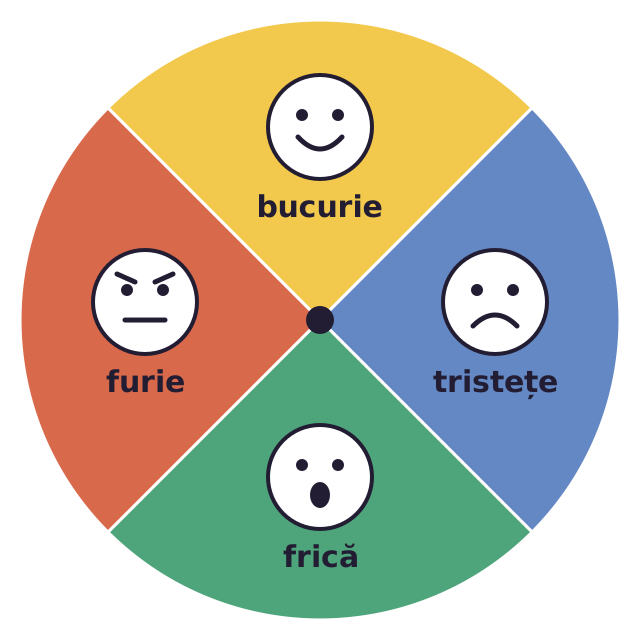
The Wheel for Younger Children
With the four basic emotions from the school curriculum and an arrow to cut out. It is the first page of the PDF.
1. For Younger Children
Kindergarten, preparatory grade, grades 1 and 2: the four basic emotions
The Morning Wheel
A wheel with four emotions and an arrow. In the morning, each child shows how they feel and says one word.
5 minutes a dayKindergarten, preparatory grade through grade 2
How to do it
- Print the wheel for younger children from the PDF below, glue it onto cardboard, and cut out the arrow.
- Attach the arrow at the center with a brass paper fastener so it can spin.
- In the morning, each child turns the arrow toward their emotion and, if they want, says why.
- Don't correct anyone's emotion. It's enough to say: “I understand, you're sad today.”
What you need
The printed wheel, cardboard, scissors, a brass paper fastener.
Takeaway: A morning habit and a word for every emotion.
Guess the Emotion
One child acts out an emotion using only their face and body. The others guess it and point to it on the wheel.
15-20 minutesPreschool, preparatory grade through grade 2
How to do it
- A child draws a card with one of the four emotions, without showing it to anyone.
- They act it out using only their face and body, without words.
- The others guess and point to the emotion on the wheel.
- Ask: “How did you figure it out?” The children learn to notice eyebrows, mouths, and shoulders.
What you need
Cards with the four emotions, the wheel.
Takeaway: The children notice more easily how others are feeling.
The Story with Pauses
Read a story and pause at the key moments: what is the character feeling?
20-30 minutesPreschool, preparatory grade through grade 2
How to do it
- Choose a story the children already know.
- At each key moment, stop reading and ask: “What is the character feeling right now?”
- The children point to the emotion on the wheel and say how they figured it out.
- At the end: “What helped the character feel better?”
What you need
A storybook, the wheel.
Takeaway: The children connect emotions to events, not just to faces.
What Helps Me When...
For each emotion, the children draw something that helps them. The drawings become the class poster.
30 minutesPreschool, preparatory grade through grade 2
How to do it
- Divide a large sheet of paper into four sections, one for each emotion.
- Ask: “What helps you when you're sad? What about when you're angry? Or when you're scared?”
- Each child draws or names one thing: a hug, three deep breaths, talking to the teacher.
- The poster stays on display so they can use it anytime.
What you need
A large sheet of paper, colored pencils.
Takeaway: The class poster: “What helps me when...”
2. For Older Students
Grades 3-6: the eight emotions and their intensity
The Emotion Thermometer
Students put the words on each petal of the wheel in order, from mild to intense.
30-40 minutesGrades 3-6
How to do it
- Prepare cards with the 24 words from the wheel, shuffled.
- In teams, students group them by emotion and put them in order: annoyance, anger, rage.
- Compare with the wheel. Where did you disagree?
- Discuss: “At what level is it easiest for you to stop?”
What you need
Cards with the 24 words, the large wheel from the PDF.
Takeaway: Students know that an emotion builds gradually and that it can be stopped early.
Opposite Pairs
Students discover the pairs on the wheel: joy and sadness, trust and disgust, fear and anger, surprise and anticipation.
20-30 minutesGrades 3-6
How to do it
- Give students cards with the eight emotions.
- Working in pairs, they match the opposites two by two.
- Check on the wheel: opposites sit directly across from each other.
- Discuss the pair that surprises them most, usually fear and anger: one makes us run away, the other makes us stand up to things.
What you need
Cards with the eight emotions, the wheel.
What remains: The four pairs, written on the board.
The Wheel Journal
For one week, at the end of each day, everyone writes down the emotion of the day and how strong it was.
5 minutes a day, for one weekGrades 3-6
How to do it
- Each student gets a worksheet with five lines, one for each day.
- At the end of the day, they write down their strongest emotion and the matching word from the wheel.
- They add one sentence: what happened.
- On Friday, everyone looks back at their week. Anyone who wants to can share what they noticed.
What you need
The weekly worksheet, the wheel.
What remains: Each student's journal, which stays theirs.
What's Behind the Action
Short situations from recess: what emotion might be behind a gesture?
30 minutesGrades 3-6
How to do it
- Read a situation aloud: “A classmate slams the door and won't talk to anyone.”
- Students suggest possible emotions on the wheel and how strong they might be.
- Ask: “What might this classmate need right now?”
- Repeat with 3-4 different situations.
What you need
Situations written on cards, the wheel.
What remains: Students ask before they judge.
3. For Teenagers
Middle school and high school: combinations and more precise words
The Emotion Recipe
Two neighboring emotions on the wheel make a new emotion. Students come up with situations for each combination.
40 minutesMiddle school, high school
How to do it
- Show the combinations on the wheel: joy and trust make love, anticipation and joy make optimism.
- Each team gets two combinations.
- The team finds a real situation for each one, from a book, a movie or school life.
- The teams present them, and the class says whether they fit.
What you need
The list of combinations, from the PDF or on the board.
What remains: Students see that emotions mix and that two can exist at the same time.
More Precise Than “Fine”
Using a list of 30 words, everyone describes a day without using “fine” or “bad.”
20-30 minutesMiddle school, high school
How to do it
- Give students the list of 30 words from the PDF.
- In pairs, each student describes their day yesterday using three words from the list.
- The words “fine,” “bad,” and “okay” are off-limits.
- Discuss: What changed when you found the right word?
What you need
The word list.
Takeaway: A richer vocabulary for what they feel.
The Character on the Wheel
In literature class or after a movie: a character's emotional journey, from beginning to end.
One hourMiddle school, high school
How to do it
- Choose a character from the book you're studying or from an age-appropriate movie.
- Students choose 5-6 key moments from the story.
- For each moment, they mark the character's emotion and its intensity on the wheel.
- Discuss: What made the character move from one emotion to another?
What you need
The book or movie, the wheel, a worksheet with the key moments.
Takeaway: A map of the character's emotions, which also works well for a literature assignment.
The Class Wheel
Each student anonymously writes down their emotion of the week. The class sees the big picture.
20-30 minutesMiddle school, high school
How to do it
- During homeroom, each student anonymously writes the strongest emotion they felt that week on a slip of paper.
- The slips go on a large wheel drawn on the board.
- Discuss the big picture, not the individual slips: “A lot of worry this week. Why?”
- Together, choose one thing that would help the class next week.
What you need
Slips of paper, a large wheel on the board or on a poster sheet.
Note: The slips stay anonymous. If a slip worries you, talk to the school counselor.
Takeaway: One thing the class will do differently next week.
List of Emotions
The 24 words on the wheel: serenity, joy, ecstasy, acceptance, trust, admiration, apprehension, fear, terror, distraction, surprise, amazement, pensiveness, sadness, grief, boredom, disgust, loathing, annoyance, anger, rage, interest, anticipation, vigilance.
The eight combinations: love, submission, awe, disapproval, remorse, contempt, aggressiveness, optimism.
30 words more precise than “fine” and “bad”, for the “More Precise Than Fine” activity:
What You Can Do
Choose who you are.
If you're a parent
Name Your Own Emotions Too
“I'm tired and a little irritated, so I'm going to speak more quietly.” Children learn these words by hearing you use them.
Name It, Don't Scold
“I can see you're angry” helps more than “Stop getting so worked up.” The emotion isn't wrong. The action might be.
Keep the Wheel in Sight
On the fridge or in your child's room. In the evening, ask each other: “Where were you on the wheel today?”
Make Room for Difficult Emotions
Sadness and fear don't need to be “fixed” right away. Sometimes it's enough to just sit with your child.
Ask for Help If It Lasts
If sadness or fear lasts a long time and changes your child's life, talk to your family doctor, the school counselor, or a psychologist.
If you're a teacher
Start Class with the Wheel
One minute in the morning with the wheel for little ones tells you a lot about what the class's day will look like.
Connect it to your subject
Characters in literature, historical figures, even “tough” math problems have emotions.
Use intensity
“On the wheel, where is your anger right now? At annoyance or at rage?” The question stops the student before they act.
No names in group exercises
Exercises about the class's emotions are done anonymously. Whoever wants to can share; no one is required to.
Know when to refer
If a student seems overwhelmed, talk to the school counselor.
If you're a student
Find the exact word
Not “I feel bad,” but “I'm disappointed” or “I'm worried.” The exact word helps both you and the person listening to you.
Catch the emotion early
Annoyance is easier to stop than rage. When you feel it, take a break.
Look at others, too
A quiet classmate might be sad or scared, not upset with you. Ask them.
Talk to someone
If a difficult emotion doesn't go away, tell an adult you trust: a parent, your homeroom teacher, the school counselor.
Want to go further? Our guide on emotional intelligence and self-esteem in children shows how emotions are linked to self-confidence, and the one on conflicts between children and nonviolent communication shows how to express an emotion without hurting anyone.
Frequently Asked Questions

The association's programs are based on the ideas of John C. Maxwell, author of more than 100 books on leadership. The idea that ties them together: influence is built on character, and character is formed early.
The “iChoose,” “iDo,” and “iLead” guides used in schools were created by his nonprofit foundation, Maxwell Leadership Foundation, and Asociația Maxwell România translated and adapted them for schools in Romania. About John C. Maxwell and the schools program.
Sorin Popa, President of Asociația Maxwell România and of Maxwell Leadership România.
Last reviewed: November 16, 2026. Written by the Asociația Maxwell România team.
Sources
The facts on this page come from the works listed below. The activities and the translations of the words on the wheel are our own.
- Robert Plutchik, “The Nature of Emotions,” American Scientist, vol. 89, no. 4, 2001, pp. 344-350: the article in which Plutchik explains the wheel: the eight basic emotions, the intensities, the opposite pairs, and the combinations.
- School curriculum for the Personal Development subject, preparatory grade, grade 1, and grade 2, approved by Order of the Minister no. 3418/19.03.2013: the four basic emotions children learn about and the game “The Wheel of Emotions,” suggested for the preparatory grade.
- Paul Ekman, “An argument for basic emotions,” Cognition and Emotion, vol. 6, no. 3-4, 1992, pp. 169-200: the case for basic emotions, recognized by facial expression.
- Paul Ekman and Daniel Cordaro, “What is meant by calling emotions basic,” Emotion Review, vol. 3, no. 4, 2011, pp. 364-370: the list of seven basic emotions, which includes contempt.
- Gloria Willcox, “The Feeling Wheel,” Transactional Analysis Journal, vol. 12, no. 4, 1982, pp. 274-276: the feeling wheel, with six emotions at the center and increasingly precise words toward the edge.
- Matthew D. Lieberman et al., “Putting feelings into words,” Psychological Science, vol. 18, no. 5, 2007, pp. 421-428: the study in which naming the emotion reduced the amygdala's response to negative images.
See also
Emotional Intelligence and Self-Esteem
What they are, how to recognize them in children, and how to build them, at home and at school.
Read the guide →Conflicts between children and nonviolent communication
The four steps, in kids' language, and a simple five-step mediation.
Read the guide →Bullying in Schools
What it is, how to recognize it, and what you can do as a parent, teacher, or student.
Read the guide →All our guides: Bullying in schools · Moral values · Emotional intelligence and self-esteem · Conflicts between children and nonviolent communication · Școala Altfel: activity ideas · Green Week: activities and rules · Volunteering in education · Assertive communication · Personal development, preparatory grade to grade 2
Want to bring our lessons to your school?
Teachers in the MaxLeaders program teach classroom lessons on self-esteem, relationships, communication, and choices. Write to us and we'll tell you how your school can join the program.