

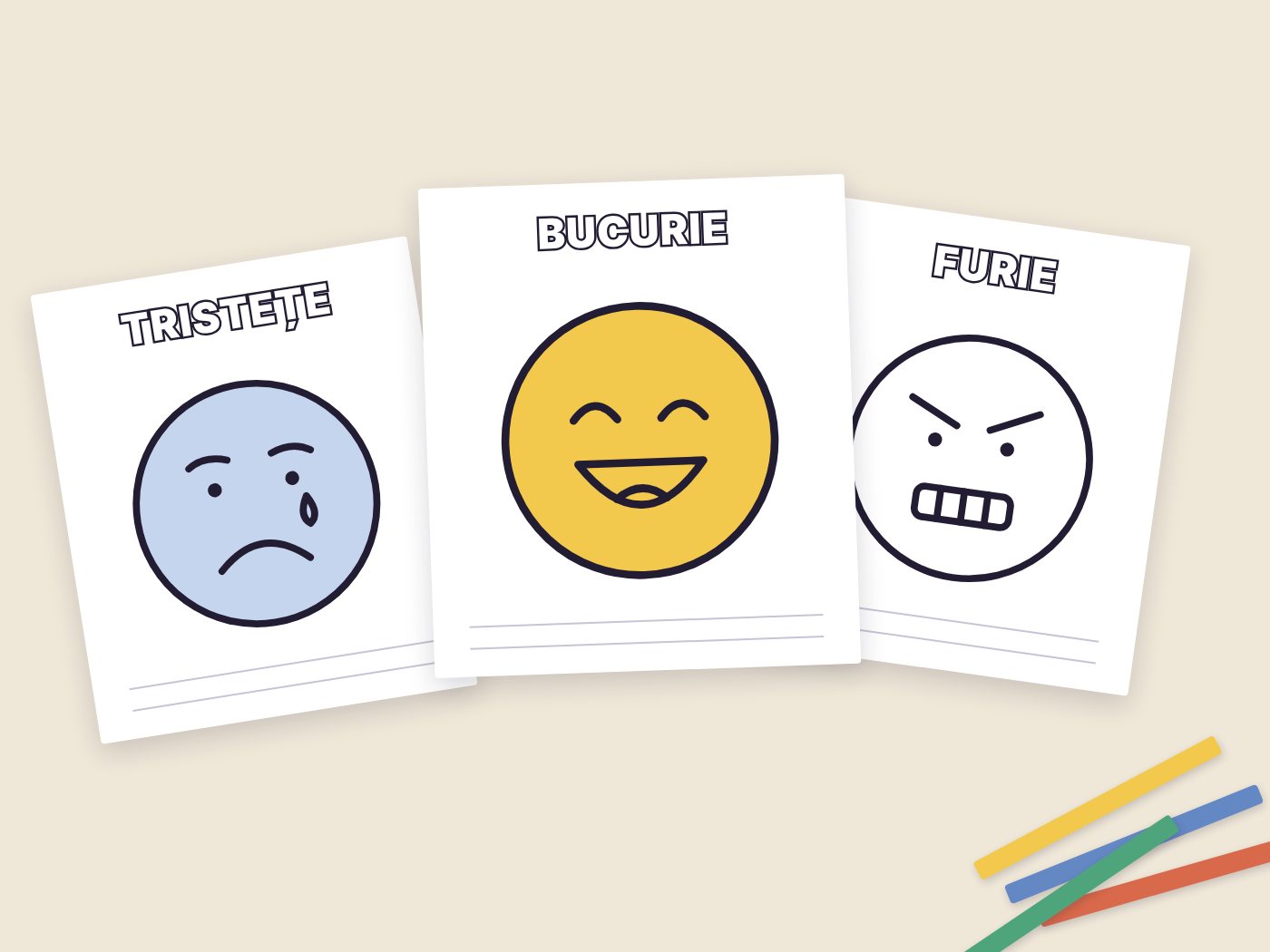
Emotions coloring pages: 8 printable faces, free
Joy, sadness, anger, fear, surprise, disgust, calm and pride: one face per page, each with a question for the child. Here you'll find the PDF, how to use it by age, and 6 games for home and the classroom.
Emotions coloring pages help children put a name to what they feel. There are eight faces, one per page: joy, sadness, anger, fear, surprise, disgust, calm and pride, each with a simple question. The PDF is free and has ten pages.
The child colors, and the adult names the emotion and asks questions. For little ones, start with four emotions, the same ones children learn at school in the early grades. Below you'll find the steps, tips by age, and 6 games.
What do you do when a child colors an emotion? 5 situations
Choose the answer that seems right to you. After each situation you'll see an explanation, and at the end you'll get the coloring pages for free.
This is not a psychological test. The answers come from this guide and its sources.
The child colors the angry face hard, in black, and says: “That's me today.”
What do you say?
Name the emotion; don't scold it. Anger isn't wrong, but the behavior can be. And the colors are the child's choice: there's no right color for anger.
A parent says there's no point talking about emotions with a young child.
What do we know about naming an emotion?
In a 2007 study, naming an emotion reduced activity in the amygdala, the part of the brain that reacts to danger. A child who has a word for what they feel can say it instead of acting it out.
You're preparing a Personal Development lesson for the preparatory grade.
How many basic emotions does the curriculum name?
The Personal Development curriculum for the preparatory grade through grade 2 names four: joy, sadness, fear and anger. All four are in the coloring pages.
The child says fear is a “bad” emotion.
What do you tell them?
For Plutchik, every emotion has a purpose. Fear keeps us safe from danger: it makes us stop, hide or run away. We don't talk about “bad” emotions, but about appropriate and inappropriate behavior.
The child has colored the sad face and is silent.
What do you do?
Sadness doesn't need to be “fixed” right away. Sometimes it's enough to sit with the child. Your words show them that the emotion can be put into words and that you've noticed it.
You got 0 out of 5 right.
You know how to talk with your child about emotions.
Now all you need is the worksheets on the table. Get the PDF with the eight faces and the “How Do I Feel Today?” page, ready to print.
You're on the right track.
Most good responses come from a single idea: the emotion gets named and accepted, while the behavior gets guided. The worksheets help you put it into practice.
It's worth reading this page all the way through.
You're not alone: adults rarely talk with children about emotions. The steps below and the worksheets help you from day one.
What's in the Worksheets
Ten A4 pages: one for the adult, eight faces to color, and a page where the child draws their own emotions.

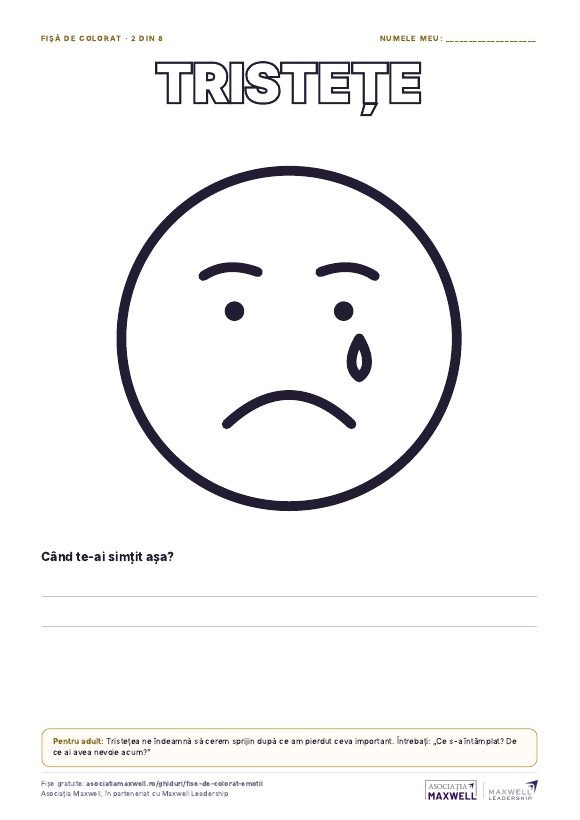

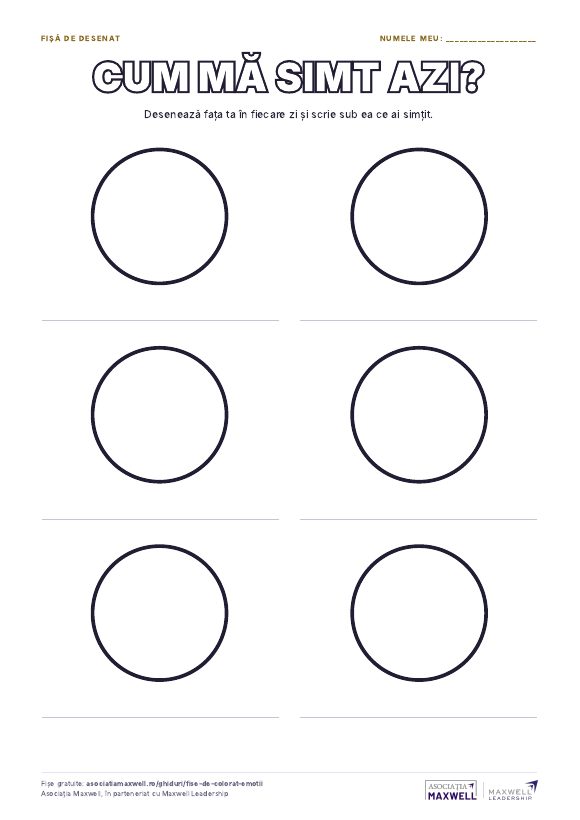
Printable Emotions Coloring Worksheets
Eight faces, the “How Do I Feel Today?” page, and a page of tips for the adult. Free, in PDF.
How to Use Them, in Three Steps
Pick a face
The child picks today's emotion or the one you want to talk about. There are no “bad” emotions: they all tell us something.
Color and name it
While the child colors, call the emotion by its name. The child chooses the colors: there's no “right” color for sadness or anger.
Talk, without rushing
The question on the worksheet opens the conversation. Listen more than you explain, and don't rush a difficult emotion to pass.
Why Naming an Emotion Helps
When we put what we feel into words, the emotion calms down. In a study published in 2007, people who named the emotion in negative images showed a weaker response in the amygdala, the part of the brain that responds to danger (Lieberman and colleagues, 2007).
Coloring worksheets do this in a language children understand. While coloring, the child has time to think about the emotion, and the adult has a chance to name it. A child who can say “I'm angry” has less need to slam the door.
The Eight Emotions in the Worksheets
The first six are basic emotions from the wheel of Robert Plutchik, explained in the Wheel of Emotions guide. We added calm and pride ourselves.
| Emotion | How it helps us | What you can ask |
|---|---|---|
| joy | makes us seek out again what made us feel good | “What made you smile today?” |
| sadness | prompts us to ask for support after we've lost something important | “What did you lose, or what did you miss?” |
| anger | gives us the energy to get past an obstacle or an injustice | “What seemed unfair to you?” |
| fear | keeps us safe from danger: it makes us stop, hide, or run away | “What felt dangerous to you?” |
| surprise | stops us for a moment so we can understand what's happening | “What didn't you expect to happen?” |
| disgust | keeps us away from things that can hurt us, like spoiled food | “What didn't you like at all?” |
| calm | we added this one: it's good for a child to know what calm looks like too, not just strong emotions | “Where do you feel calmest?” |
| pride | we added this one: pride in their effort helps a child try again | “What did you work for to get here?” |
By Age
The same sheets, used in different ways. The Personal Development curriculum for the early grades starts with four basic emotions.
Ages 3-5
Start with four faces: joy, sadness, fear and anger, the same ones children learn about at school in the early grades. The adult reads the question, and the child answers in words or with a drawing.
Ages 6-7
Use all eight faces. The child can write a word under the face or tell about something that happened. In the classroom, the sheets fit into Personal Development class.
Ages 8-9
The child fills in the “When did you feel this way?” lines on their own. The “How do I feel today?” page can be used as a one-week journal.
6 Games with the Sheets
Our suggestions, for home and for the classroom. For more, see the 12 activities in the Emotion Wheel guide.
Face of the Day
at home or in class, in the morningEveryone picks the face that matches their day and colors it in. Anyone who wants to can say why, but no one has to.
Guess the Emotion
in a group, ages 4 and upOne child makes the face from the sheet, without words. The others guess the emotion and say when they've felt it too.
The Emotion in the Story
after reading a book togetherPick the character's face at a moment in the story. Ask: “What would you have felt if you were them?”
What Would Help You?
after coloringNext to the sad or scared face, the child draws what would help them: a hug, a friend, a break.
Weekly Journal
at home, on the fridgeThe “How do I feel today?” page stays where everyone can see it. In the evening, the child draws the face of the day, and at the end of the week you look at it together.
The Class Wheel
in class, for one weekThe colored sheets are put up on a wall in a circle. Students put a mark next to their emotion, without names, and the teacher sees how the class is doing.
Frequently Asked Questions

The association's programs are based on the ideas of John C. Maxwell, author of more than 100 books on leadership. The idea that ties them together: influence is built on character, and character is formed early.
The “iChoose,” “iDo,” and “iLead” guides used in schools were created by his nonprofit foundation, Maxwell Leadership Foundation, and Asociația Maxwell România translated and adapted them for schools in Romania. About John C. Maxwell and the schools program.
Sorin Popa, President of Asociația Maxwell România and of Maxwell Leadership România.
Last reviewed: November 19, 2026. Written by the Asociația Maxwell România team.
Sources
The facts on this page come from the works below. The drawings, questions, age-based tips, and games are our own.
- Robert Plutchik, “The Nature of Emotions,” American Scientist, vol. 89, no. 4, 2001, pp. 344-350: the basic emotions and the purpose of each one.
- The school curriculum for the Personal Development subject, preparatory grade, 1st grade, and 2nd grade, approved by Minister's Order no. 3418/19.03.2013: the four basic emotions children learn in the early grades.
- Matthew D. Lieberman et al., “Putting feelings into words,” Psychological Science, vol. 18, no. 5, 2007, pp. 421-428: the study in which naming the emotion reduced the amygdala's response to negative images.
- The “Wheel of Emotions” guide from Asociația Maxwell România: Plutchik's wheel explained, 12 age-based activities, and a printable wheel.
See also
The Emotion Wheel
The eight basic emotions, their intensities, 12 age-based activities, and a printable wheel.
Read the guide →Emotional Intelligence and Self-Esteem
What they are, how to recognize them in children, and how to build them, at home and at school.
Read the guide →Personal Development in the Early Grades
What children learn from the preparatory grade through 2nd grade, with activities and printable worksheets.
Read the guide →All our guides: Bullying in Schools · Moral Values · Emotional Intelligence and Self-Esteem · Conflicts Between Children and Nonviolent Communication · Școala Altfel: Activity Ideas · Green Week: Activities and Rules · The Emotion Wheel · Volunteering in Education · Assertive Communication · Personal Development, Grades K-2 · Classroom Rules · Empathy in Children · Christmas in the Classroom · Form 230, Step by Step · Advent Calendar of Good Deeds · Reward Chart for Kids · Letter to Santa Claus
Want to bring our lessons to your school?
Teachers in the MaxLeaders program teach classroom lessons on self-esteem, relationships, communication, and choices. Write to us and we'll tell you how your school can join the program.